L'article a bien été placé dans le panier

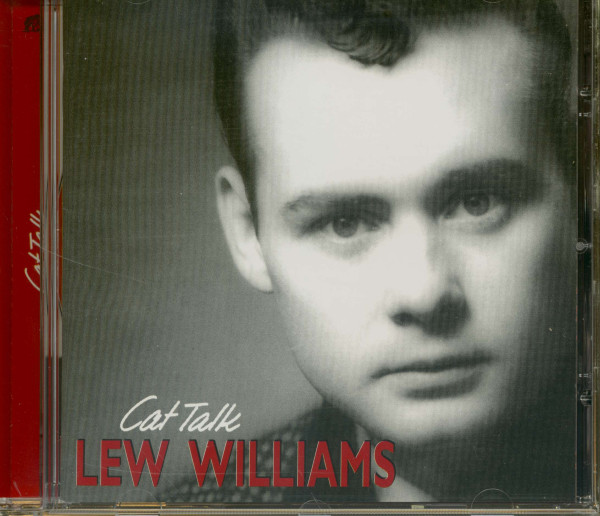
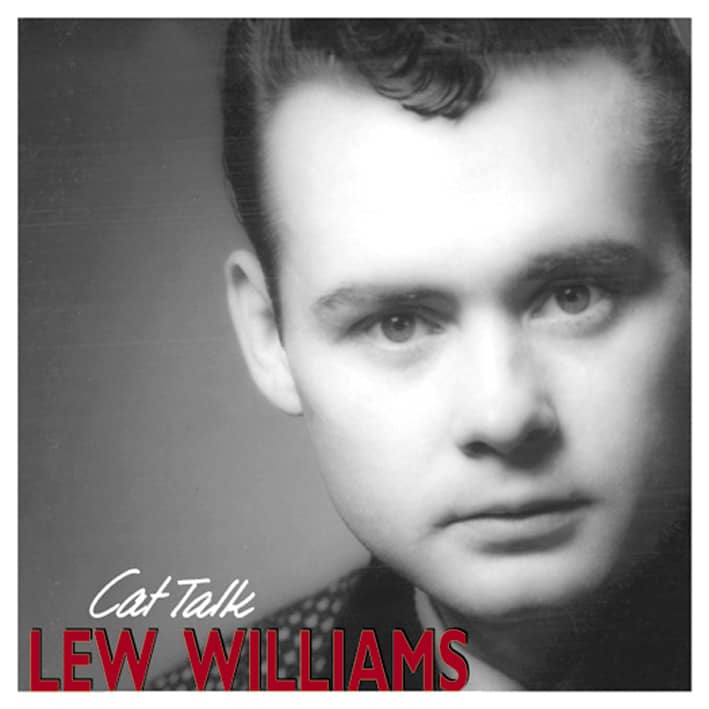
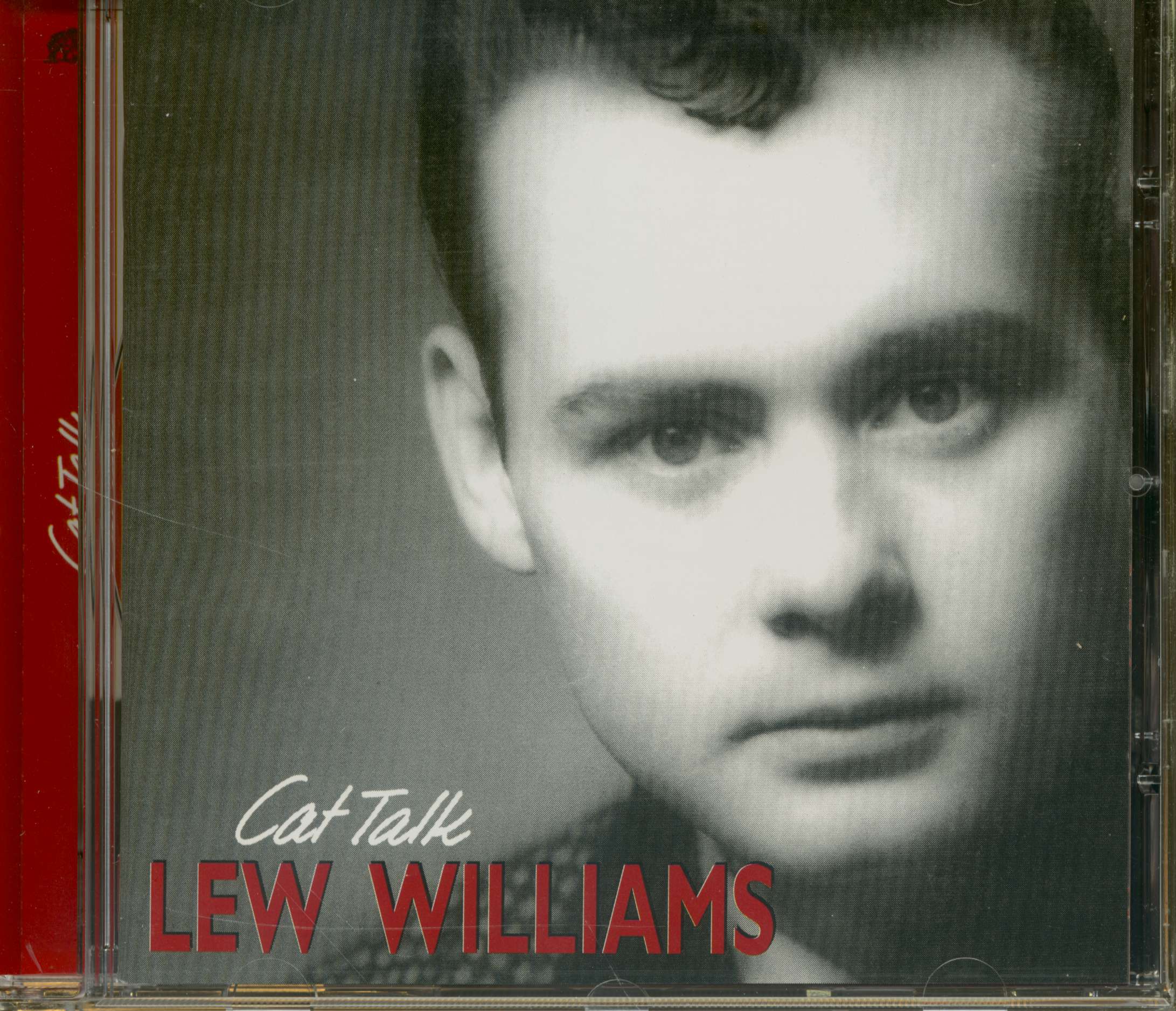
Lew Williams Cat Talk
Écoutez l'échantillon:
 
0:00
0:00
Cet article est supprimé et ne peut plus être commandé !
Avertissez-moi lorsque l'article sera de nouveau disponible.
Veuillez saisir la série de nombres dans le champ de texte suivant.

  • BCD16347
  • 0.115
P Maintenant bonus points
The original Imperial masters plus rarities from Lew's private collection.LEW WILLIAMS : PARLER...plus

Lew Williams: Cat Talk

The original Imperial masters plus rarities from Lew's private collection.LEW WILLIAMS : PARLER CHAT
Kevin Coffey

Pendant des décennies, Lew Williams est resté l'un des mystères les plus intrigants du rockabilly. Son petit corpus d'œuvres est bien connu : six de ses huit enregistrements Imperial de 1955-56 ont été réédités à intervalles réguliers depuis 1977, repris, voire plagiés. Des compilateurs et des annotateurs comme Bill Millar, qui l'a qualifié de « Cab Calloway du rockabilly », ont reconnu que Lew Williams avait quelque chose d'unique : une touche presque jazzy et des paroles jivey, cockeyed, parfois audacieuses et souvent étonnamment souples. Des morceaux comme Cat Talk, Centipede, Bop Bop Ba Doo Bop et Something I Said sont depuis longtemps considérés comme des classiques du rockabilly ou du rock and roll des débuts. Un seul article de Folk And Country Songs datant de 1957 a permis d'établir une biographie très sommaire, mais ce qu'il est advenu de lui par la suite est resté un mystère.

Jusqu'à présent, du moins. Lew Williams est bel et bien vivant. Face à ce manque de connaissances, des spéculations, parfois erronées, ont inévitablement circulé sur Lew et les influences qui ont façonné sa musique et son patois de motard. Ce recueil remet les pendules à l'heure. Il contient 29 titres, dont plus de la moitié proviennent de la collection privée de Williams et n'ont jamais été publiés, toutes ses faces sorties, ainsi que d'incroyables démos inédites comme une version de Cat Talk de juin 1954, le superbe My New Pink Suedes de fin 1955, la version originale de Something I Said de 1953 en version country combo, et bien d'autres. Les faces retracent l'évolution de Lew, depuis ses débuts de jeune chanteur de country jusqu'à ses premières explorations révélatrices de la « Cat Music », en passant par ses faces rockabilly singulières pour Imperial, puis les démos ultérieures réalisées alors qu'il se concentrait de plus en plus sur l'écriture de chansons et son dernier essai en tant qu'artiste pour la filiale de Dot à Hamilton en 1958.

Lewis Wayne Williams est né le 12 janvier 1934 à Chillicothe, au Texas, à mi-chemin entre Fort Worth/Dallas et Amarillo, à la pointe sud-est du Texas, troisième fils d'Ernest et Callie Williams. Ernest était un fermier dont l'exploitation a fait faillite au début de la Grande Dépression. Il s'est ensuite lancé dans la menuiserie. Les frères de Lew, Ernest et Ed, beaucoup plus âgés, ont servi pendant la Seconde Guerre mondiale et Ed, décédé en 1982, était un mitrailleur de queue de B-24 hautement décoré.

« Je suppose que je pourrais toujours chanter », se souvient Lew. « Je faisais des spectacles et des concours amateurs alors que je n'avais pas plus de quatre ans. J'avais une bonne voix et j'étais assez fort pour être entendu. KVWC à Vernon organisait tout le temps des spectacles amateurs. Pendant l'été, parfois une fois par mois, KVWC organisait un spectacle depuis Chillicothe. Croyez-le ou non, la scène était le grand porche d'une maison et les gens apportaient des chaises, des palettes et des oreillers et s'asseyaient sur sa pelouse pour regarder le spectacle. J'avais probablement cinq ou six ans et je chantais juste des chansons du moment. Ce n'était pas forcément de la country, c'était ce qui était populaire à l'époque. J'ai grandi en écoutant des artistes comme Ernest Tubb et Jimmie Davis. L'une des chansons que je chantais était « You Are My Sunshine ». Je chantais beaucoup Gene Autry. Je gagnais si souvent ces concours que je m'attendais à gagner... En grandissant (probablement vers neuf ans), je ne voulais plus me produire et j'ai refusé de participer aux spectacles amateurs... Je trouvais que c'était un peu efféminé de participer à certains de ces spectacles. Aucun de mes amis n'y participait. Mais ma mère trouvait ça génial, elle adorait l'idée. Mais je ne voulais pas vraiment faire ça, alors j'étais content quand elle a arrêté de me pousser à le faire. Quand nous avons déménagé à Dallas, j'avais presque 12 ans et je ne me souviens pas avoir chanté du tout. »

Vers la fin des années 40, lorsque Lew entra au lycée à Dallas, cela commença à changer. Dans les années prospères de l'après-guerre, les jeunes comme Lew étaient bombardés d'influences. « Après la Seconde Guerre mondiale, il y avait une telle différence. Les gens que j'appelle les rockabillies originaux, ces gars étaient trop jeunes pour la Seconde Guerre mondiale. Notre culture musicale était principalement basée sur les big bands, Glenn Miller, Tommy Dorsey et tous les autres. Nous connaissions bien ces chansons. En même temps, nous écoutions Ernest Tubb, la vraie country et, bien sûr, le Grand Ole Opry... Les chansons de Jimmie Rodgers - je chantais « All around the watertank... » [« Waiting For A Train. »]. En fait, je chantais encore ça à l'université. Nous allions au cinéma le samedi et nous entendions les cow-boys qui chantaient : Gene Autry, Roy Rogers et ainsi de suite... Mais nous avions un tel passé. Nous ne nous sommes pas rendu compte, quand nous avons commencé à jouer, que tout cela allait nous influencer, mais c'était inévitable. »

Propriétés de l'article: Lew Williams: Cat Talk

Williams, Lew - Cat Talk CD 1
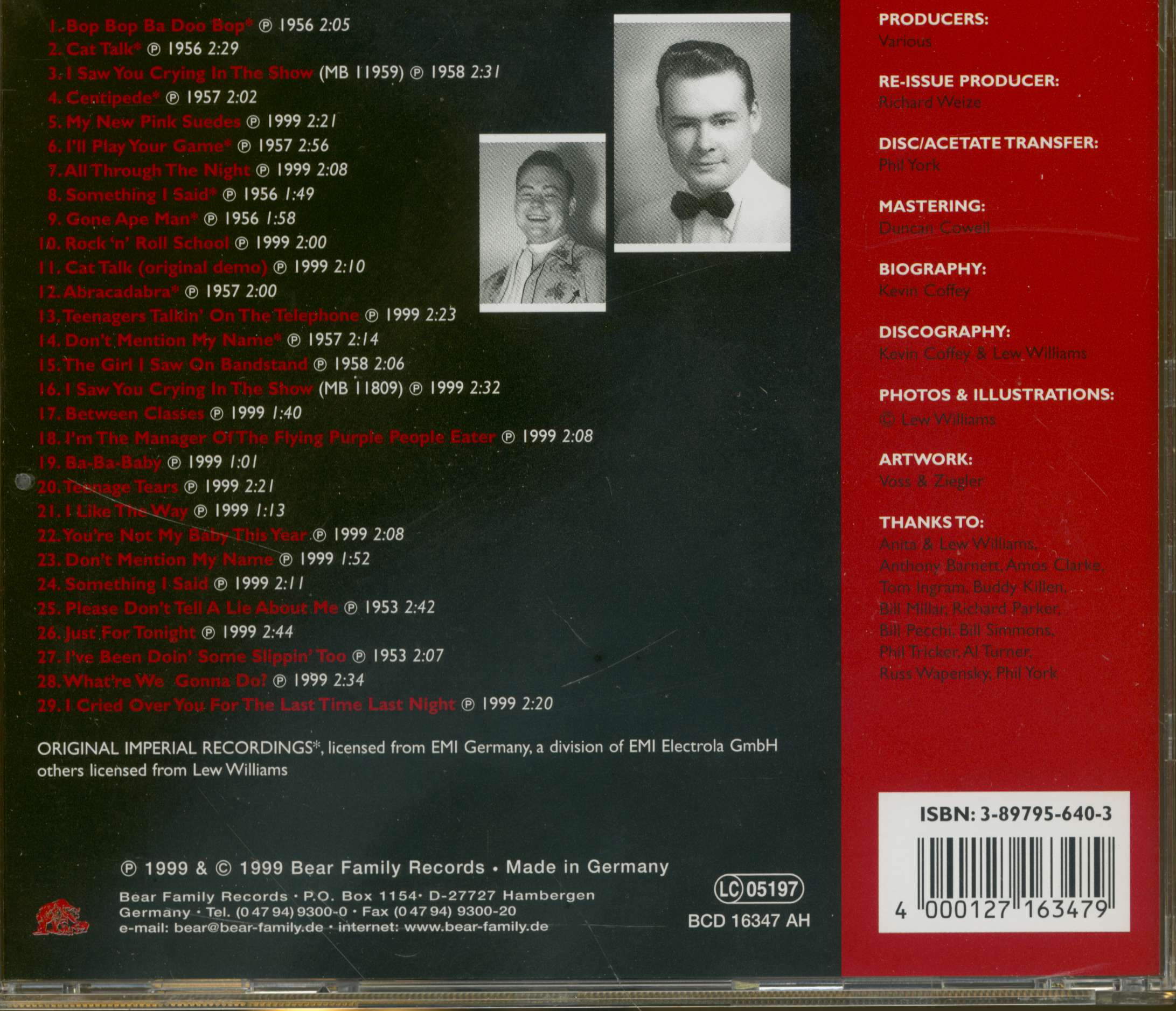
01 Bop Bop Ba Doo Bop Lew Williams
02 Cat Talk (original demo) Lew Williams
03 I Saw You Crying In The Show (MB 11959) Lew Williams
04 Centipede Lew Williams
05 My New Pink Suedes Lew Williams
06 I'll Play Your Game Lew Williams
07 All Through The Night Lew Williams
08 Something I Said Lew Williams
09 Gone Ape Man Lew Williams
10 Rock 'n' Roll School Lew Williams
11 Cat Talk Lew Williams
12 Abracadabra Lew Williams
13 Teenagers Talkin' On The Telephone Lew Williams
14 Don't Mention My Name Lew Williams
15 The Girl I Saw On Bandstand Lew Williams
16 I Saw You Crying In The Show (MB 11809) Lew Williams
17 Between Classes Lew Williams
18 I'm The Manager Of The Purple Peopler Eater Lew Williams
19 Ba-Ba-Baby Lew Williams
20 Teenage Tears Lew Williams
21 I Like The Way Lew Williams
22 You're Not My Baby This Year Lew Williams
23 Don't Mention My Name (original demo) Lew Williams
24 Something I Said (original demo) Lew Williams
25 Just For Tonight Lew Williams
26 Please Don't Tell A Lie About Me Lew Williams
27 I've Been Doin' Some Slippin' Too Lew Williams
28 What're We Gonna Do? Lew Williams
29 I Cried For You The Last Time Last Night Lew Williams
LEW WILLIAMS : CAT TALK Kevin Coffey For decades, Lew Williams has remained one of the most... plus
"Lew Williams"

LEW WILLIAMS : CAT TALK

Kevin Coffey

For decades, Lew Williams has remained one of the most intriguing mysteries of rockabilly. His small body of work is well-known: six of his eight Imperial recordings from 1955-56 have been reissued at regular intervals since 1977, covered, even plagiarized. Compilers and annotators like Bill Millar, who called him the "Cab Calloway of rockabilly," acknowledged that there was something unique about Lew Williams -- an almost jazzy feel and jivey, cockeyed, sometimes daring and often surprisingly supple lyrics -- and sides like Cat Talk, Centipede, Bop Bop Ba Doo Bop, and Something I Said have long been considered rockabilly or early rock and roll classics. A lone article from 'Folk And Country Songs' from 1957 established a very basic biography, but what became of him after that remained a tantalizing blank.

Until now, that is. Lew Williams is alive and well. Amid the dearth of knowledge, there was inevitably speculation, some of it misguided, about Lew and the influences that shaped his music and his hepcat patois. This collection sets the record straight. It contains 29 tracks -- more than half from Williams' private collection and never before released -- all his issued sides, plus amazing unissued demos like a June 1954 version of Cat Talk, the stunning My New Pink Suedes from late 1955, the original 1953 country combo version of Something I Said, and many others. The sides trace Lew's development from a young country singer through early, telling explorations of 'Cat Music,' and his singular rockabilly sides for Imperial, to subsequent demos made when he was concentrating increasingly on songwriting and his final stab as a recording artist for Dot's Hamilton subsidiary in 1958.

Lewis Wayne Williams was born on January 12, 1934 in Chillicothe, Texas, halfway between Fort Worth/Dallas and Amarillo on the Southeastern cusp of the Texas panhandle, the third son of Ernest and Callie Williams. Ernest was a farmer whose farm failed early in the Depression. He took up carpentry thereafter. Lew's brothers Ernest and Ed, much older, served in World War II and Ed, who died in 1982, was a highly decorated B-24 tailgunner.

"I suppose I could always sing," Lew recalls. "I was entertaining on amateur shows and contests when I was no more than four. I had a good voice and was loud enough to be heard. KVWC in Vernon used to have amateur shows all the time. During the summer, on some occasions, maybe monthly, KVWC did a show from Chillicothe. Believe it or not, the stage was a woman's big front porch, and people would bring chairs or pallets and pillows and sit on her lawn to watch the show. I was probably five or six and I just sang songs of the day. It wouldn't necessarily be country, it'd be whatever was popular at the time. I grew up listening to artists like Ernest Tubb, and Jimmie Davis -- one of the songs I used to sing was 'You Are My Sunshine.' I used to sing a lot of Gene Autry. I won those contests so often, I kind of expected to win...As I got older (probably nine), I didn't want to perform and refused to participate in the amateur shows...I thought it was kind of sissy being on some of those shows. None of my friends were on them. But my mother thought that was great, got a kick out of the idea. But I didn't really want to do that, so I was glad when she quit pushing me to do it. When we moved to Dallas, I was almost 12 and I don't know that I did any singing at all."

Around the time Lew entered high school in Dallas at the end of the '40s, that began to change. In the prosperous postwar years, youngsters like Lew were barraged with influences. "After World War II, there was such a difference. The people that I call the original rockabillies, those guys were too young for World War II. A lot of our musical background would be big band stuff -- Glenn Miller, Tommy Dorsey and all this. We'd be familiar with those songs. At the same time, we were listening to Ernest Tubb, listening to the real country, and, of course, the Grand Ole Opry ... Jimmie Rodgers songs -– I'd sing, 'All around the watertank..' ['Waiting For A Train.']. Actually I still sang that in college. We'd go to the movies on Saturday and we'd hear the singing cowboys: Gene Autry, Roy Rogers and so forth...But we had such a background. We didn't realize when we started playing that all of that would be influencing us, but it had to."

Black music, from folk country blues to sophisticated jump rhythm and blues, began to have a particularly strong effect. "Now back when I was in high school...the music that the black singers and black bands did was called Race music. There were not a lot of stations that played it. I don't think there was a black station in Dallas...but I know this: We'd go down to some record shops that had these neat records by these black artists...One that influenced me -- I must have sung this hundreds and hundreds of times and even performed when I first started playing guitar -- was one called 'Sixty-Minute Man' [a major hit for Billy Ward & the Dominoes in 1951 and considered a major seminal rock 'n' roll record by many]." Others who caught Lew's ear were the rediscovered folk blues legend Leadbelly and Houston-based jump blues bandleader-guitarist Gatemouth Brown.


Lire, écr. et débatt. des analyses…plus
Évaluations de clients pour "Cat Talk"
Écrire une évaluation
Les évaluations sont publiées après vérification.

Les champs suivis d'un * sont des champs obligatoires.

Sentimental Favorites - Treasury Of Love Songs (2-LP)
Connie Francis: Sentimental Favorites - Treasury Of Love Songs... Art-Nr.: LP829792-C

Immédiatement disponible à l'expédition, Délai de livraison** env. 1 à 3 jours ouvrés.

17,95 € 19,95 €
Go, Connie, Go (7inch, 45rpm, BC, PS)
FRANCIS, Connie: Go, Connie, Go (7inch, 45rpm, BC, PS) Art-Nr.: 45863350

Immédiatement disponible à l'expédition, Délai de livraison** env. 1 à 3 jours ouvrés.

9,95 €
The Jim Reeves Radio Show: February 25-28,1958 (CD)
Jim Reeves: The Jim Reeves Radio Show: February 25-28,1958... Art-Nr.: ACD25005

Immédiatement disponible à l'expédition, Délai de livraison** env. 1 à 3 jours ouvrés.

9,95 € 15,95 €
CONSEIL !
Holy Cow! - The Best Of Lee Dorsey (LP, Cut-Out)
Lee Dorsey: Holy Cow! - The Best Of Lee Dorsey (LP, Cut-Out) Art-Nr.: LPALB68387-C

Immédiatement disponible à l'expédition, Délai de livraison** env. 1 à 3 jours ouvrés.

19,95 €
The Golden Hits Of Tommy Sands (LP)
Tommy Sands: The Golden Hits Of Tommy Sands (LP) Art-Nr.: LPAUS1021

Immédiatement disponible à l'expédition, Délai de livraison** env. 1 à 3 jours ouvrés.

14,95 € 17,95 €
Bop 'N' Stroll With Aubrey Cagle (LP)
Aubrey Cagle: Bop 'N' Stroll With Aubrey Cagle (LP) Art-Nr.: LPBLK7718

Article doit être commandé

24,95 €
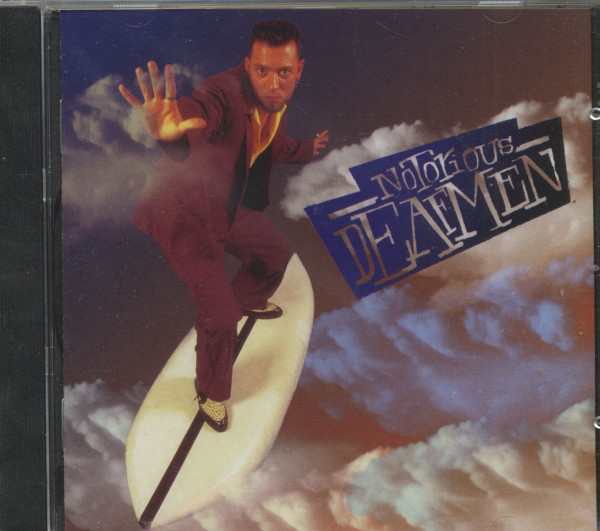
Notorious Deafmen (CD)
NOTORIOUS DEAFMEN: Notorious Deafmen (CD) Art-Nr.: CDHBA002

Cet article est supprimé et ne peut plus être commandé !

18,95 €
Greatest Hits
Die Chinesischen Glückskekse: Greatest Hits Art-Nr.: CDDCG001

seulement 1x disponibles
Immédiatement disponible à l'expédition, Délai de livraison** env. 1 à 3 jours ouvrés.

16,95 €
Sea Of Love - incl. 9 prev.unissued masters
Phil Phillips: Sea Of Love - incl. 9 prev.unissued masters Art-Nr.: BCD16981

Immédiatement disponible à l'expédition, Délai de livraison** env. 1 à 3 jours ouvrés.

14,95 € 16,95 €
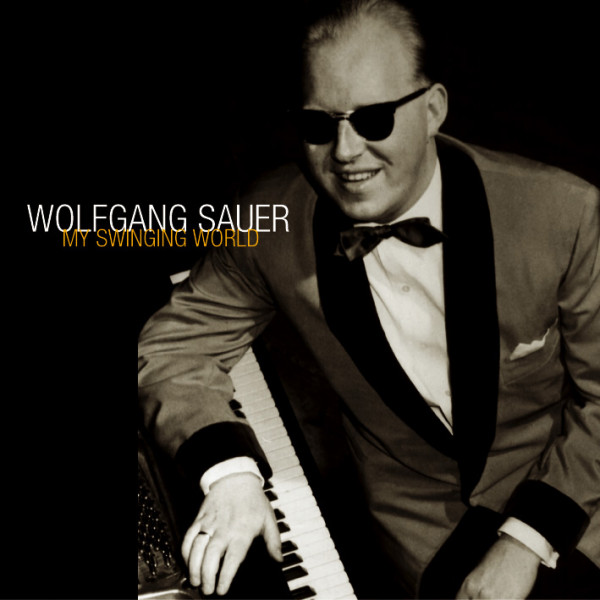
My Swinging World
Wolfgang Sauer: My Swinging World Art-Nr.: BCD16653

Immédiatement disponible à l'expédition, Délai de livraison** env. 1 à 3 jours ouvrés.

13,95 € 15,95 €
NOUVEAU
Ray Campi Rocks (CD)
Ray Campi: Ray Campi Rocks (CD) Art-Nr.: BCD17790

Immédiatement disponible à l'expédition, Délai de livraison** env. 1 à 3 jours ouvrés.

17,95 € 19,95 €
Some City, Somewhere (CD)
Redferrin: Some City, Somewhere (CD) Art-Nr.: CD834335

seulement 1x disponibles
Immédiatement disponible à l'expédition, Délai de livraison** env. 1 à 3 jours ouvrés.

17,95 €
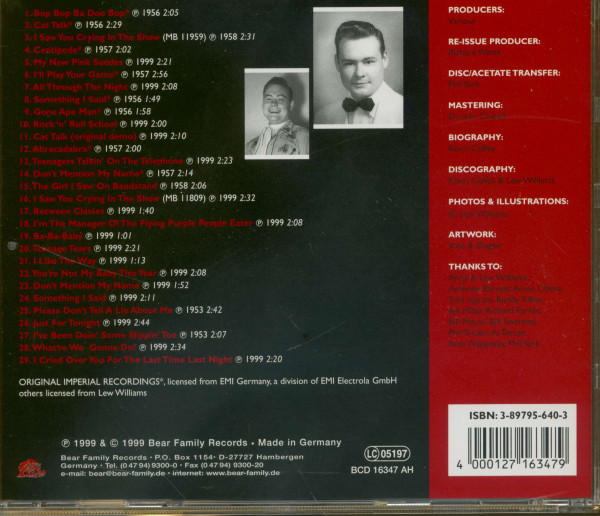
Tracklist
Williams, Lew - Cat Talk CD 1
01 Bop Bop Ba Doo Bop
02 Cat Talk (original demo)
03 I Saw You Crying In The Show (MB 11959)
04 Centipede
05 My New Pink Suedes
06 I'll Play Your Game
07 All Through The Night
08 Something I Said
09 Gone Ape Man
10 Rock 'n' Roll School
11 Cat Talk
12 Abracadabra
13 Teenagers Talkin' On The Telephone
14 Don't Mention My Name
15 The Girl I Saw On Bandstand
16 I Saw You Crying In The Show (MB 11809)
17 Between Classes
18 I'm The Manager Of The Purple Peopler Eater
19 Ba-Ba-Baby
20 Teenage Tears
21 I Like The Way
22 You're Not My Baby This Year
23 Don't Mention My Name (original demo)
24 Something I Said (original demo)
25 Just For Tonight
26 Please Don't Tell A Lie About Me
27 I've Been Doin' Some Slippin' Too
28 What're We Gonna Do?
29 I Cried For You The Last Time Last Night